| .agents/skills | ||
| .claude/skills | ||
| docs | ||
| images | ||
| src/hosts | ||
| tests | ||
| .gitignore | ||
| .python-version | ||
| AGENTS.md | ||
| CONTEXT.md | ||
| CONTRIBUTING.md | ||
| favicon.svg | ||
| LICENSE | ||
| mise.lock | ||
| mise.toml | ||
| pyproject.toml | ||
| README.md | ||
| skills-lock.json | ||
| uv.lock | ||


hosts
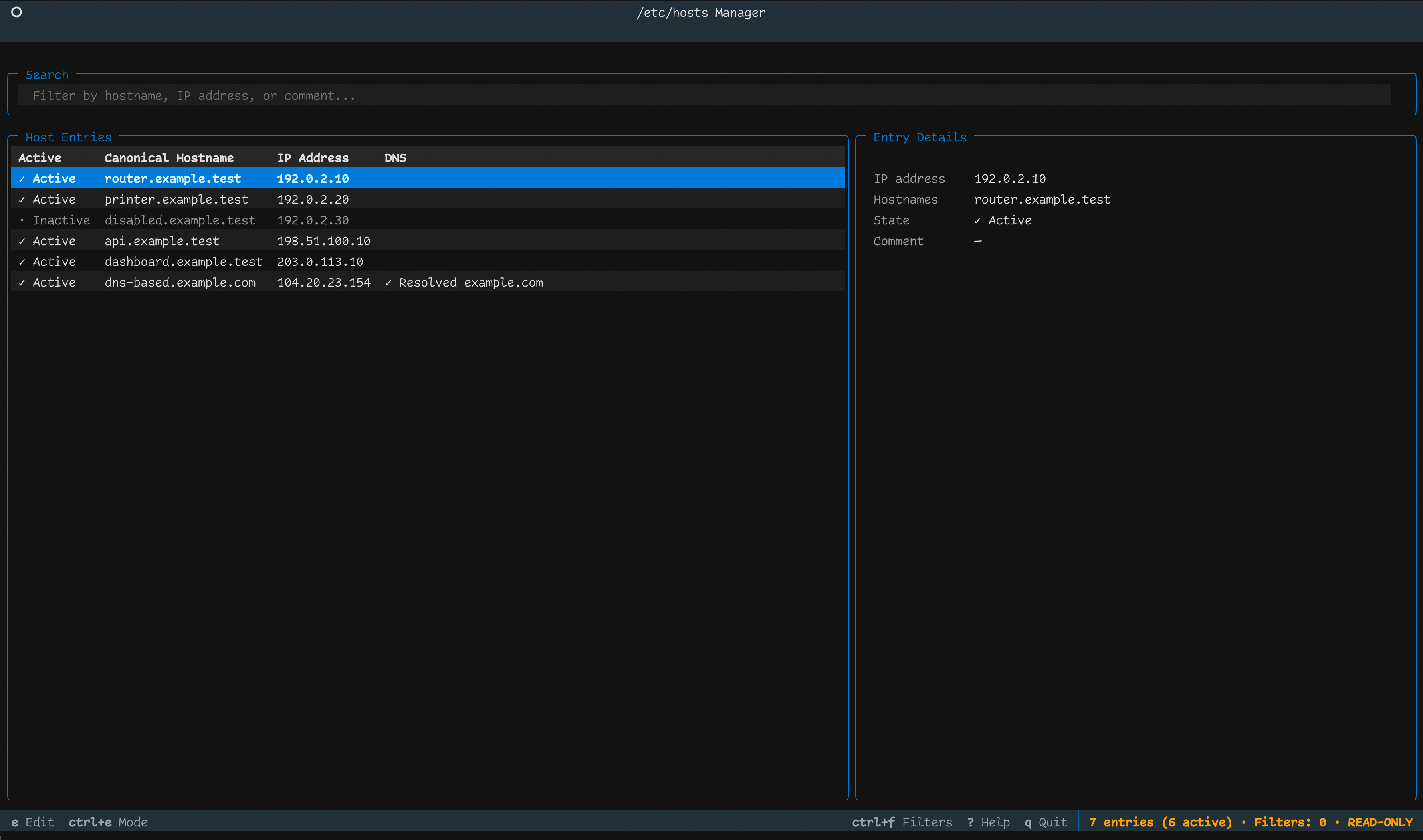
A keyboard-first terminal application for inspecting and editing /etc/hosts
on macOS and Linux.
Warning
hostsis alpha software. It can replace a system file usingsudo, and several recovery and persistence workflows still have known limitations. Read the user guide before entering Privileged Mode.
What it does
- Browses, searches, and sorts active and inactive Host Entries.
- Filters Host Entries by status, entry type, DNS resolution state, and search fields.
- Hides or shows protected localhost and broadcasthost Default Entries.
- Adds, edits, deletes, activates, deactivates, and reorders Host Entries.
- Creates DNS Entries and manually refreshes their resolved IP addresses.
- Gates every
/etc/hostsmutation behind an explicit Privileged Mode. - Creates a timestamped Pre-edit Backup before Privileged Mode begins.
- Restores the current session's Pre-edit Backup after explicit confirmation.
- Supports undo and redo during the current Privileged Mode session.
- Exports Host Entries as hosts, JSON, or CSV files. In Privileged Mode, imports can add Host Entries or replace the Hosts File after confirmation.
The application starts in Read-only Mode. Default Entries cannot be edited, deleted, activated, deactivated, or moved.
See Accessibility and terminal compatibility for the supported keyboard and terminal baseline, plus known assistive-technology limitations.
Requirements
- macOS or Linux with
/etc/hostsandsudo - Python 3.13 or newer
- uv
The project is designed for macOS and Linux, but does not yet publish a tested platform matrix.
Run
The normal user entry point runs the current revision from the canonical Forgejo repository:
uvx git+https://git.s1q.dev/phg/hosts.git
Caution
This command follows the repository's default branch because the project does not yet publish versioned releases. Review the current project state and known limitations before granting sudo access.
Press Ctrl+E to enter Privileged Mode. The application uses an existing sudo
authorization or displays a temporary authentication notice before returning
control of the terminal to sudo and its configured PAM authentication method.
It then creates a Pre-edit Backup before enabling changes. hosts never
collects or handles authentication credentials.
Start with the user guide for the complete workflow, including persistence behavior and manual recovery.
Essential keys
| Key | Action |
|---|---|
Up / Down |
Select a Host Entry |
Ctrl+E |
Enter or leave Privileged Mode |
b |
Review and restore the session Pre-edit Backup |
n |
Add a Host Entry |
Shift+N |
Add a Host Entry based on the selected Host Entry (N fallback without enhanced keyboard support; Caps Lock also triggers it) |
e |
Open the selected Host Entry in the Entry Editor |
d |
Delete the selected Host Entry |
Space |
Activate or deactivate the selected Host Entry |
Ctrl+S |
Save the current in-memory state |
Ctrl+F |
Open advanced filters |
Ctrl+X |
Export Host Entries (hosts, JSON, or CSV) |
Ctrl+O |
Import Host Entries from hosts, JSON, or CSV (Privileged Mode) |
? |
Show help |
q or Ctrl+C |
Quit |
Mutating keys work only in Privileged Mode. See the complete key reference for navigation, sorting, DNS refresh, movement, undo, and redo.
Safety and known limitations
- Reloading discards unsaved in-memory state.
- The TUI can restore only the Pre-edit Backup associated with the current Privileged Mode session; it does not list old backups or manage retention.
- Leaving Privileged Mode clears the application's session state but does not alter the user's cached sudo timestamp.
- Serialization preserves Host Entries and comments semantically, but normalizes spacing, comment placement, and blank lines. It is not a byte-for-byte round trip.
Read Persistence and recovery before making system-file changes.
Develop and contribute
Clone the repository for development:
git clone https://git.s1q.dev/phg/hosts.git
cd hosts
mise install
mise run sync
mise run app
mise installs the locked Python and uv versions and provides the project's development tasks.
See CONTRIBUTING.md for code boundaries, safety contracts,
tests, linting, and documentation expectations. Domain language lives in
CONTEXT.md, and consequential design decisions live in
docs/adr/.
Report bugs and request features in the Forgejo issue tracker.
License
Licensed under the MIT License.